


Artwork by Pawel Bugucki
Last week I presented at the 79th Tobacco Science Research Conference. I was grateful to be invited as part of a session called “How Can a Smoke-Free Future Be Realized and Sustained in the United States?”
This was an excellent opportunity to start some uncomfortable discussions that need to be had sooner rather than later about the long-term sustainability of THR. I want to emphasize that these are my own personal views (not my clients’) as a researcher who has extensively studied population trends. Kudos to Andrea Vansickel (Altria) for organizing this important forward-thinking panel.
My talk was titled “Harm Reduction in Never-Smokers? Rethinking Population Health Implications in an Era of Declining Cigarette Smoking.” I’m writing this up for those of you who missed my talk or want to see the content again.
Success of Tobacco Harm Reduction (THR) at the Population Level
Throughout this talk, I focus on e-cigarettes specifically because that’s where most of the current research focuses. But the same concepts apply to other noncombusted products, including snus, heated tobacco products, nicotine pouches, etc.
E-cigarettes have had a measurable and substantial benefit at the population level in the US. In a recent paper led by my colleague Sooyong Kim which I covered in a previous Substack post, we examine the past 10 years of US adults in NHIS (National Health Interview Survey) quarterly data:
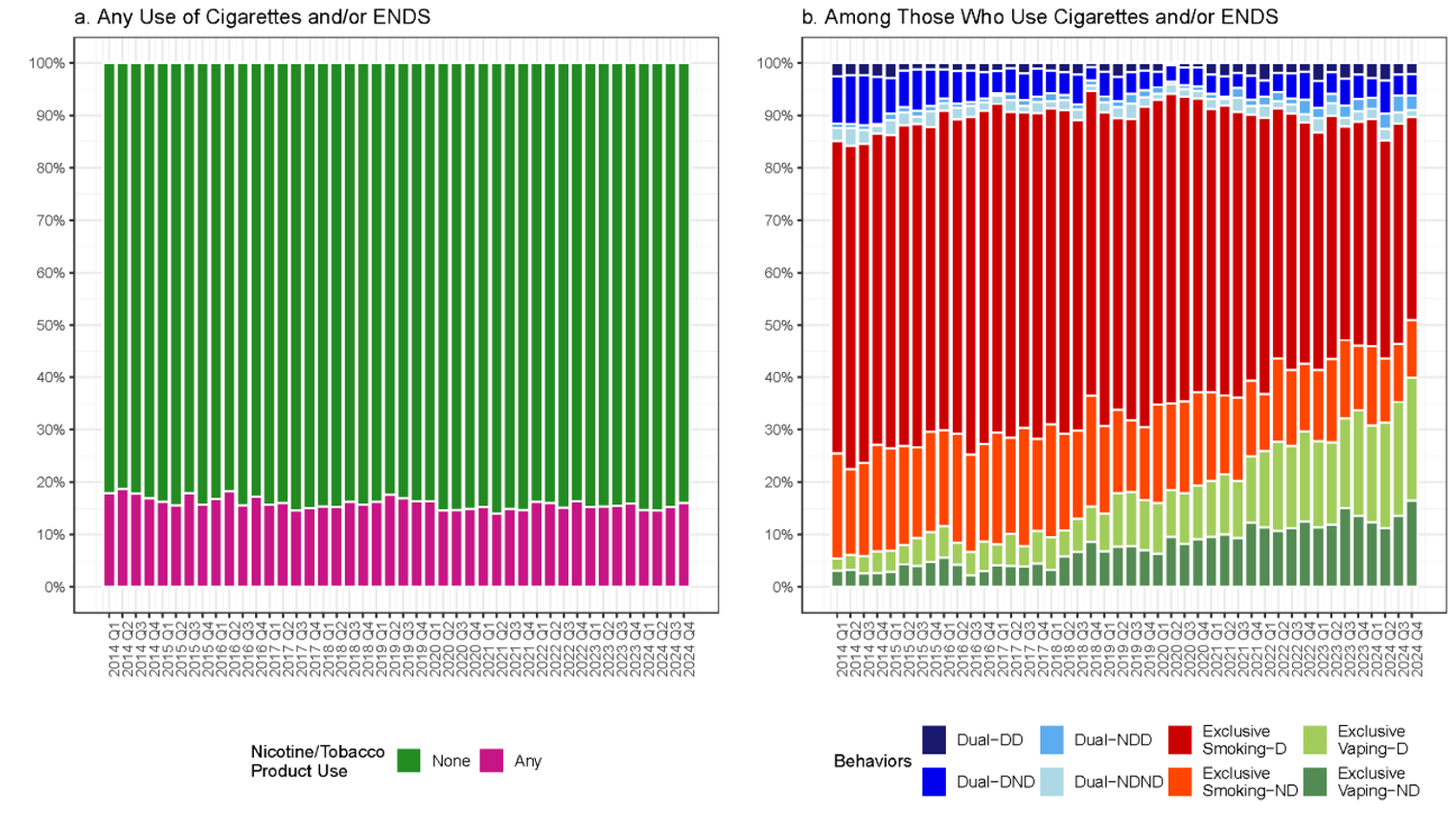
Two things are immediately evident:
The prevalence of any nicotine use has remained remarkably stable over the past 10 years (pink bars in the left-hand plot).
Within those pink bars, the consumption has shifted by a large amount away from exclusive cigarette smoking (red and orange) and towards exclusive vaping (shades of green).
As a side note, for all the alarmism about dual use (e.g., that for every “switcher” from smoking to vaping, there are 2.3 dual users created), dual use is a small proportion of overall nicotine use, and is stable over time rather than growing with e-cigarette prevalence.
This population shift away from smoking has favorable public health implications, since cigarettes are so much more harmful. I speculate that most people would interpret the plots above as e-cigarettes being effective for smoking cessation (see Cochrane review) or, failing a preplanned quit attempt, as a lower-risk alternative for cigarettes (Shiffman et al., 2025).
But is switching or cessation the main reason for the population success we see?
Are Adults who Smoke the Only Beneficiary of THR?
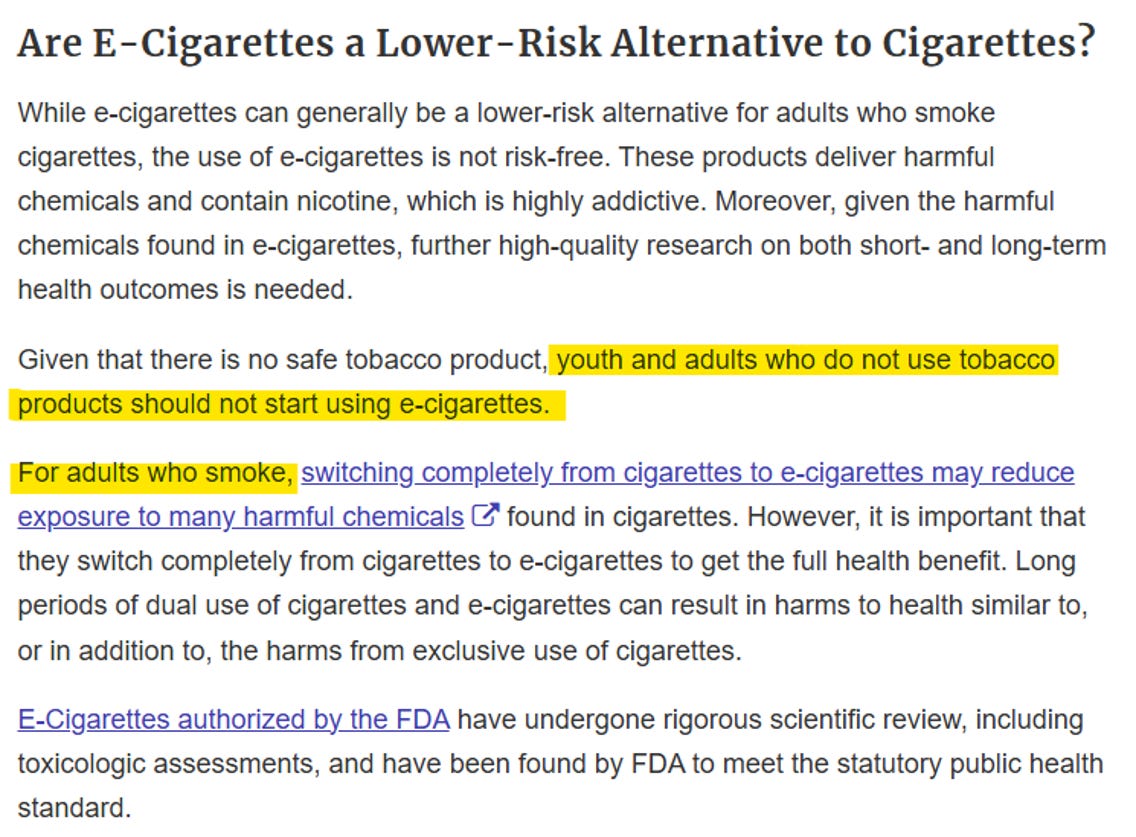
Below is a screenshot from the FDA’s page on the relative risk of different tobacco products. Not to pick on the FDA specifically, because many other researchers and groups are saying the same thing, but this is as close to an “official” source as possible in the US.
The FDA recognizes the value of e-cigarettes for THR but caveats this in several ways; most relevant to this post, that THR only applies to adults who (currently) smoke (yellow highlights are mine).
At first glance this makes sense because adults who smoke are actively harming themselves with each additional cigarette they smoke, making the benefits of switching obvious. But let’s take a closer look at the population trends, this time broken up by age group, going from younger to older as you go down:
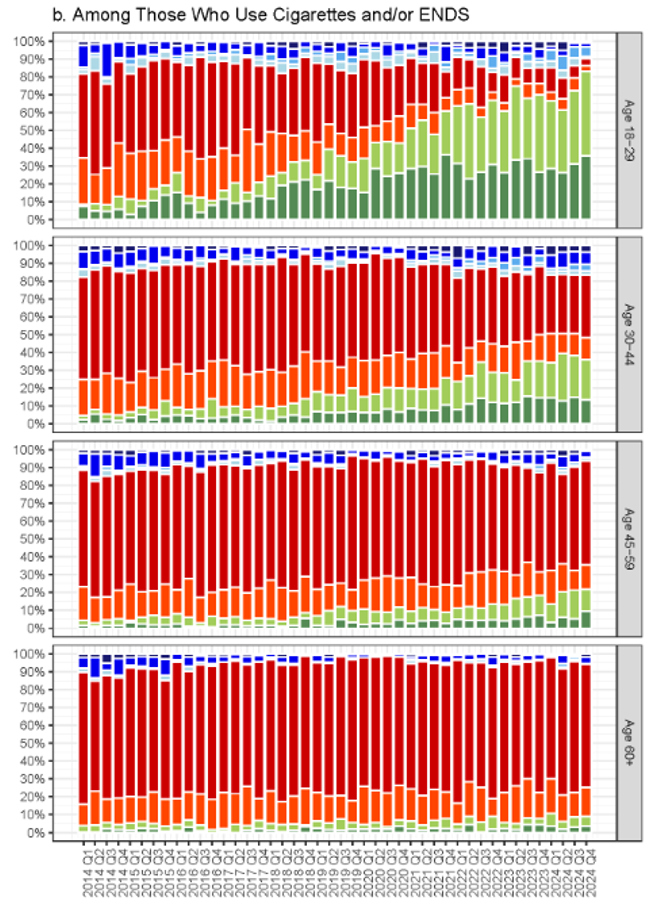
So the averaged population trends I first showed turn out to mainly be driven by younger age groups (18-29 year-olds and, to a lesser extent, 30-44 year-olds). Adults aged 60+, on the other hand, unfortunately seem to be stuck exclusively smoking, with only a small amount who switched and a smattering of dual use.
Taking the above trends and creating trend lines of exclusive smoking for each age group confirms that older adults have essentially no change in exclusive smoking, while younger age groups have are progressively larger declines:
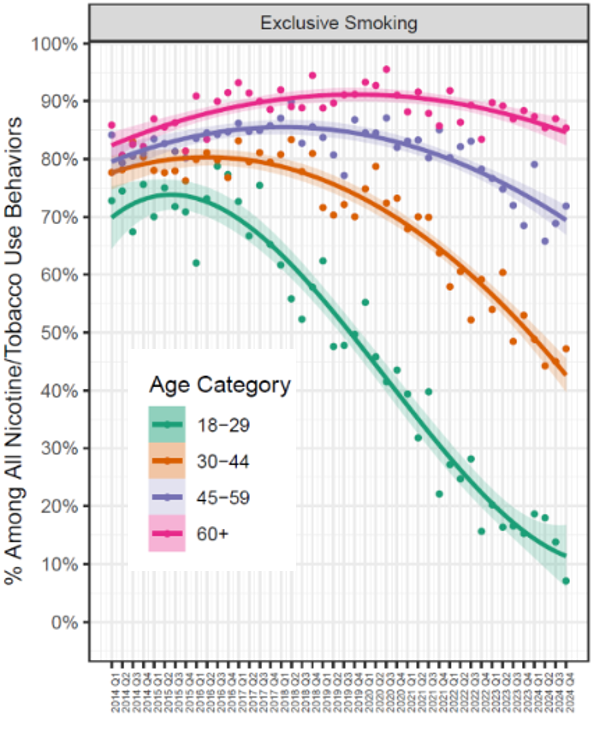
Smoking is plummeting in the youngest age group, reaching only about 10% of all nicotine use.
Now think about how the population will change over the next 10, 20, or 30 years. The groups who are predominantly smoking will either reach the end of their lifespan or (hopefully) extend their lifespan by quitting or switching to a less-harmful product. Either way, the population of people who smoke will decline. Combined with incoming younger age groups who presumably will further extend these shifts, the population burden of cigarette smoking will resemble those at the top of the figure: vanishing cigarette smoking, replaced by e-cigarettes and perhaps pouches next.
Scandinavia can provide a glimpse into the future, as Karl Erik Lund showed in a preprint: Over the past 100 years, tobacco/nicotine consumption has shifted from one product to the next, from roll-your-own to cigarettes to snus (and perhaps now, pouches), all while there is a steady demand for nicotine.
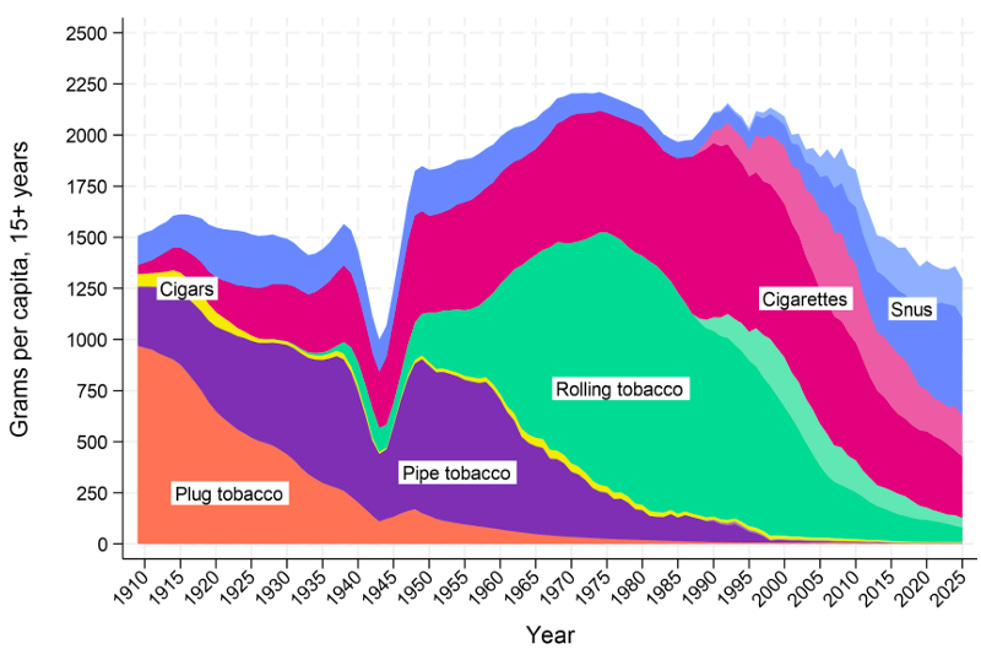
Norway and Sweden have achieved very low rates of tobacco smoking which means that many snus users never smoked cigarettes. But the low rates of combustible tobacco use has favorable population health impacts, including low rates of lung cancer and myocardial infarction (Foulds et al., 2003).
Does this mean THR has an expiration date? If the only acceptable benefit of THR is helping adults who smoke to switch, what does that mean as the smoking population nearly vanishes?
The Population with the Greatest Benefit Cannot Credit Switching Alone
Let’s look at the youngest age group again (18-29 year-olds). Exclusive smoking (red & orange) has nearly vanished and dual use is not much more common. A large majority of nicotine use in this age group is exclusive vaping.

And remember, the use of any nicotine is remarkably stable over this massive shift in specific products. The uptake of e-cigarettes is exactly the same magnitude as the decline in cigarettes, and occurs over the same time period.
The same trends were documented in an analysis of data from young adults (18-24 years) in PATH (Population Assessment of Tobacco and Health) in young adults (Sanford et al., 2024):
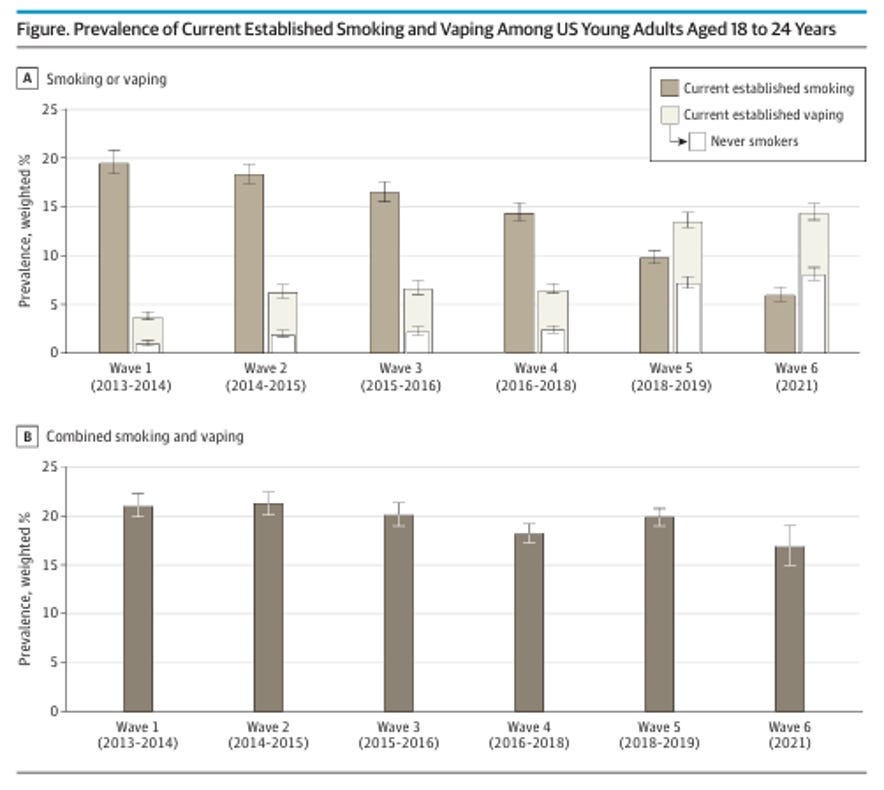
The bottom panel confirms that overall nicotine use was mostly stable or slightly decreasing over this 8-year period (equivalent to the pink bars in my paper). The top panel shows the shift in products, away from cigarettes and towards e-cigarettes (equivalent to the multi-colored bars in my paper). But this paper shows something mine didn’t: an increase in nicotine users who never smoked cigarettes to begin with.
This is often interpreted pessimistically as “e-cigarettes addicting a whole new generation” with the implication that these never-smoking vapers would have otherwise remained nicotine free for life if it weren’t for e-cigarettes. The same people claim that the decline in smoking would have happened anyway because of tobacco control policies.
But this interpretation defies plausibility because, again, overall nicotine use is stable. What are the chances that, if e-cigarette uptake is completely unrelated to the decline in cigarette smoking, that it would occur over exactly the same time scale and in exactly the right amount to maintain a near-perfect equilibrium of overall nicotine use?
My interpretation is that the decline in cigarette smoking is not a shift in the demand for nicotine. It’s a shift in preference for the delivery method.
Young adults have, by far, the lowest rates of cigarette smoking. They can’t have achieved this success purely by switching from smoking to vaping, because many of them never smoked cigarettes to begin with. Young adults are reaping the greatest benefits of THR but switching alone — the only “officially accepted” form of THR — cannot explain this.
Other, Unofficial, Harder-to-See Forms of THR
A big part of how I changed my mind on the e-cigarette gateway hypothesis was researching population trends. In the figure below, I modeled youth smoking trends before e-cigarettes were widely available (~2010) and projected what youth smoking would have looked like if it had continued unabated (blue line):
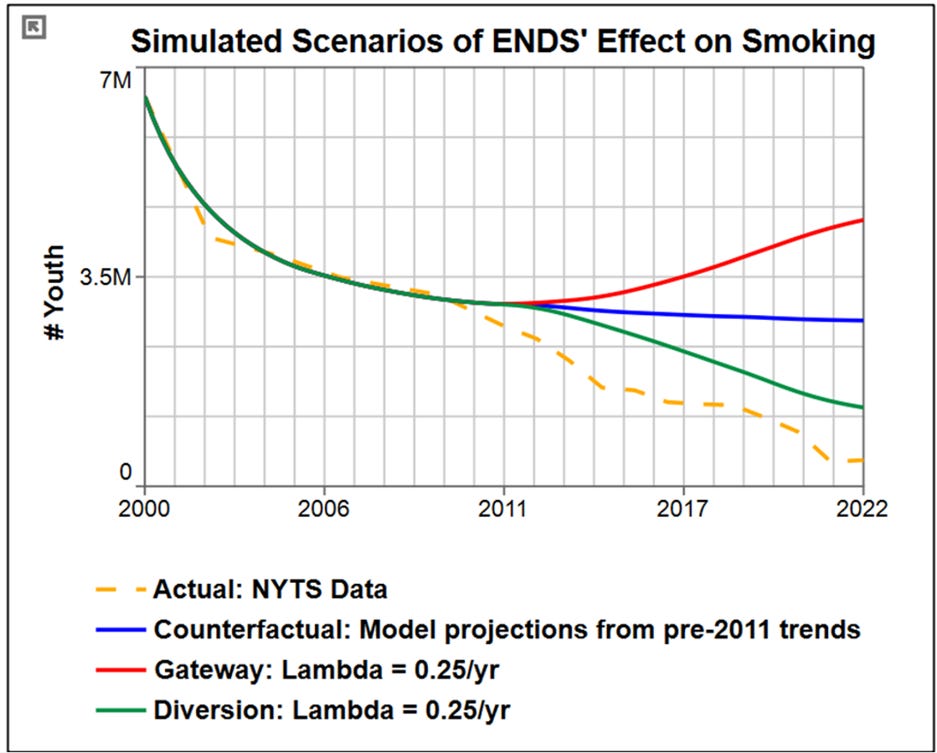
Not only does the gateway hypothesis (red line) drastically overpredict the number of youth who smoke (yellow dashed line), but even the “null” scenario (where cigarette trends continue unabated) overpredicts actual smoking. In fact, it takes quite a large diversion effect (where youth who use e-cigarettes are prevented from ever smoking) to get close to explaining the large declines in smoking that we see.
Population trends alone don’t prove that diversion is happening, but this is my interpretation after triangulating with other types of evidence. Other academics also showed that the decline in youth smoking accelerated after e-cigarettes became widely used (Levy et al., 2019; Meza et al., 2020).
Returning to my main question, does THR apply only to adults who currently smoke? We can group the population into 3 categories:
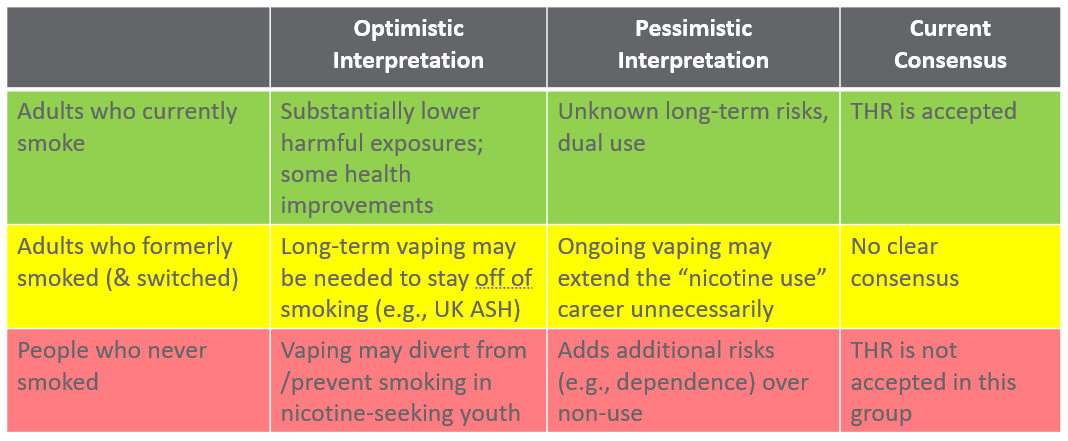
THR in the first group (current smoking) is no longer very controversial: switching from smoking to vaping can substantially lower harmful exposures and result in some health improvements (e.g., respiratory symptoms; Polosa et al., 2020; 2025). While some are still worried about unknown long-term risks or dual use (a whole separate issue I hope to debunk soon), this type of THR is officially accepted in the US.
For adults who formerly smoked and switched to vaping, there’s not a lot of research on THR in this group yet and no clear consensus. Evidence is beginning to accumulate, but it’s very mixed, with some indications that former smokers may need to vape long-term to stay off of cigarettes (e.g., this is alluded to the recent ASH Great Britain fact sheet) while others are worried whether former smokers could have otherwise quit all nicotine might be extending their total duration of nicotine use unnecessarily.
The most controversial, of course, is people who never smoked. THR is explicitly rejected in this group because vaping in never-smokers is seen as adding additional risks (e.g., nicotine dependence) over non-use. But this assumes the counterfactual is continued non-use of nicotine; i.e. that never-smokers would have have led a nicotine-free life if it weren’t for e-cigarettes.
But what if that assumption is wrong? If diversion is occurring, as I believe, then for some proportion of youth (maybe just under 20% according to my NHIS trends paper), it’s an either/or choice between cigarettes and e-cigarettes. If the counterfactual is smoking, isn’t vaping instead considered a valid form of harm reduction? To paraphrase Clive Bates, why would someone have to do the more harmful thing first before they can benefit from THR?
The counterfactual entirely determines whether vaping in never-smokers is a net benefit or a net harm, but it is rarely explicitly acknowledged.
It’s the same concept as prevention, which is well established in tobacco control. Tobacco control focuses on prevention (of initiating smoking), cessation (for those who already smoke), and an intermediate stage of “prevescalation” (escalating from initiation to established use). Can e-cigarettes serve the same functions?
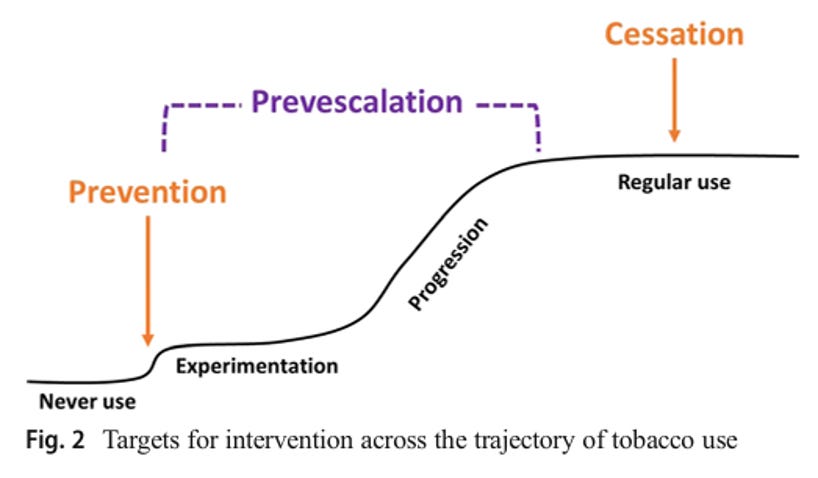
Source: Villanti et al., 2018
How to Quantify “Harder to See” Forms of THR?
As I stated above, the counterfactual is essential to knowing whether e-cigarette uptake is a net harm or a net benefit. But the counterfactual, by definition, is not directly observable and relies on complicated estimation methods. However, just because it’s “harder to see,” it doesn’t mean it’s not happening. It’s impossible to say for a given individual what they would have done otherwise (without e-cigarettes) but these counterfactuals make a big difference at the population level; e.g. they are needed to explain why youth smoking rates are so low.
One way of estimating counterfactuals is causal inference methods, for researchers who have access to very detailed observational data. For example, there are sophisticated matching algorithms that can identify 2 groups in the dataset that are similar on all measured characteristics and only differ on vaping status. The idea is that (if there are no missing confounding factors) then any difference can be more confidently attributed to vaping. But the “no missing confounding factors” assumption is almost always violated since surveys don’t, and maybe can’t, measure every relevant confounding variable.
Another way of estimating counterfactuals is to make projections of population trends, such as I did for the gateway question previously. I have an analysis in progress where I am trying to parse out the population benefits of THR into switching (for current smokers) vs. maintenance of switching (for former smokers) vs. diversion (for never smokers). I had hoped to present some preliminary results by this conference, but to be honest, I haven’t had much time for my solo projects and was getting weird results that are pretty clearly an issue with the details of my modeling (e.g. overfitting and projecting skyrocketing smoking rates). If anyone with population modeling experience wants to collaborate, let me know.
The Elephant in the Room
Surely one of the big reasons why very few people are talking about broader forms of THR — in people who formerly smoked or never smoked — is that the critics will make claims about e-cigarettes “addicting a whole new generation.” But this implies that the generation being addicted would not otherwise be addicted. The population trends, which show remarkable stability of nicotine demand by ~20% of adults, suggest that most of these never-smoking vapers would still be addicted without e-cigarettes, since they’d likely be smoking cigarettes. And have much worse health effects to boot.
Instead, we have to recognize the latent demand for nicotine and allow people a lower-risk way to engage in those behaviors if they choose to do so. We do this already in many other situations: we tell high school students, “don’t have sex, but if you do, use a condom.” Motorcycles are highly dangerous, but we don’t tell people not to ride them; we say “if you ride a motorcycle, use a helmet.”
There can be a permanent place for a lower-risk product in a population: to displace something much worse that there’s a persistent demand for. Does anyone think that if the legal alcohol industry were to be waved away with a magic wand, that people wouldn’t return to the days of making moonshine in bathtubs? Alcohol use carries risks, but the legal, regulated alcohol industry prevents much worse risks. It’s implicitly accepted that there’s a stable demand for alcohol and that society needs a permanent way to access safer alcohol products.
Recommendations
What can we do? A few recommendations from short-term to longer-term:
Start talking about this, even though it’s uncomfortable and controversial. I am not the first to talk about this but I hope to spur some discussion. Kicking the can down the road will help no one once smoking has been mostly displaced in the population and the main argument we’re hinging our case on has become moot.
Revisit framing and messaging to “future proof” arguments for THR. I agree with prioritizing THR among adults who currently smoke, especially older adults, but it’s not the only valid form of THR.
A good example of a “future-proof” improvement to framing is from Philip Morris International (PMI). PMI previously said: “our smoke-free products are for adult smokers who would otherwise continue to smoke” but the “continue” specifies that people need to actively be smoking in order to benefit. More recently, they have dropped this word, saying “for adults who would otherwise smoke” (press release on Zyn MRTP) which could include anyone with the counterfactual of smoking, regardless of what they’re currently doing.
Start including these “harder to see” forms of THR in research. This will help normalize these discussions and hopefully spur some interesting research. Perhaps an easier first step is to study maintenance of cigarette abstinence among former smokers. It’s less controversial to talk about THR in former smokers (though not without opposition) than THR in never-smokers.
As I mentioned above, I am trying to directly quantify these using prevalence trend modeling. For papers that include simulation models, include important counterfactuals such as the diversion effect. This should be trivial since most models include a gateway effect that is varied in strength over different sensitivity analyses; diversion is simply setting that in the negative direction.
A good example of a simulation model constructed thoughtfully with respect to these issues is Altria’s population model of on! pouches. The model includes “would-be smokers” which allows a diversion effect (i.e., non-smokers who initiate with pouches and are prevented from ever initiating cigarette smoking). Double kudos to these authors, because they also include a “would-be quitting smoker” pathway (i.e., former smokers who would have quit nicotine entirely but use pouches) — a counterfactual with unfavorable (if minor) public health implications but one that’s important to include when considering overall population health impacts. Again, these counterfactuals are impossible to show at the individual level but are really making a difference at the population level.
Grapple with bigger-picture questions, such as: is there a latent demand for nicotine in the population? This may vary by setting and by population, but in the US it appears to be just under 20% of the adult population who seeks out nicotine. If there is a latent and stable demand for nicotine in the population, what would that mean for the implicit or explicit counterfactual in research questions, and what would that mean for THR?
Conclusion
Restricting the “official” recognition of THR only as an off-ramp from cigarette smoking is shortsighted: it means that the entire justification for THR will become moot after a couple of decades as smoking prevalence declines.
Smoking prevalence has declined faster among the groups with the highest e-cigarette uptake (Foxon et al., 2024), and it can’t be predominantly because of switching/quitting with e-cigarettes. As impressive as the population evidence is for e-cigarettes helping people move away from cigarettes, I believe it is dwarfed by the diversion effect. The populations benefiting the most (e.g., young adults) are not smoking to begin with, yet e-cigarette use has exactly displaced cigarette smoking to maintain the population equilibrium of nicotine use.
This is controversial because critics of e-cigarettes make “youth epidemic” claims (which I’ve debunked here). But the population evidence shows that vaping is no more common than smoking used to be. There is value to public health, and precedent for, having a lower-risk product permanently displace something worse, for people who choose to engage in that behavior.
We need to work towards recognizing the wider value of THR for the entire population, including switching (for adults who currently smoke), maintenance of non-smoking (for those who have already switched), and diversion (for those who have never smoked but are predisposed to use nicotine).
Thanks again to TSRC, the panel organizer (Andrea Vansickel), and my great co-panelists who also had excellent presentations.

From left: Andrea Vansickel (Altria), Jason Kennedy (Altria), Ryan Seltzer (Safety in Numbers), Derek Pope (Altria), me, Andrea Patton (Centre for Substance Use Research), Jess Seifert (PMI). TSRC 2026 Panel, “How Can a Smoke-Free Future be Realized and Sustained in the United States?”
How interesting that nicotine use has remained stable over time. I love your question, "What are the chances that, if e-cigarette uptake is completely unrelated to the decline in cigarette smoking, that it would occur over exactly the same time scale and in exactly the right amount to maintain a near-perfect equilibrium of overall nicotine use?" Thank you for being among the first to ask questions on why we're limiting THR to only one subgroup.
Yes, the availability of lower risk nicotine mitigates the risk of nicotine seeking persons using cigarettes. So even among non-smokers there is a value.
Compare the current cohort of people who use e-cigarettes to the many patients who I treated in my clinics. With rare exception, they all started in their youth. There is a wide range of nicotine dependence. Some quit easily and some will never quit. Some are self-medicating. https://edwardanselm.substack.com/p/why-is-your-patient-still-smoking?r=fp3rx
It would be important to better understand self-medication.